 The Energy Manual
Chapter 07 · 2026-10-17
What Happens to Your Body When You Sleep 6 Hours for a Week
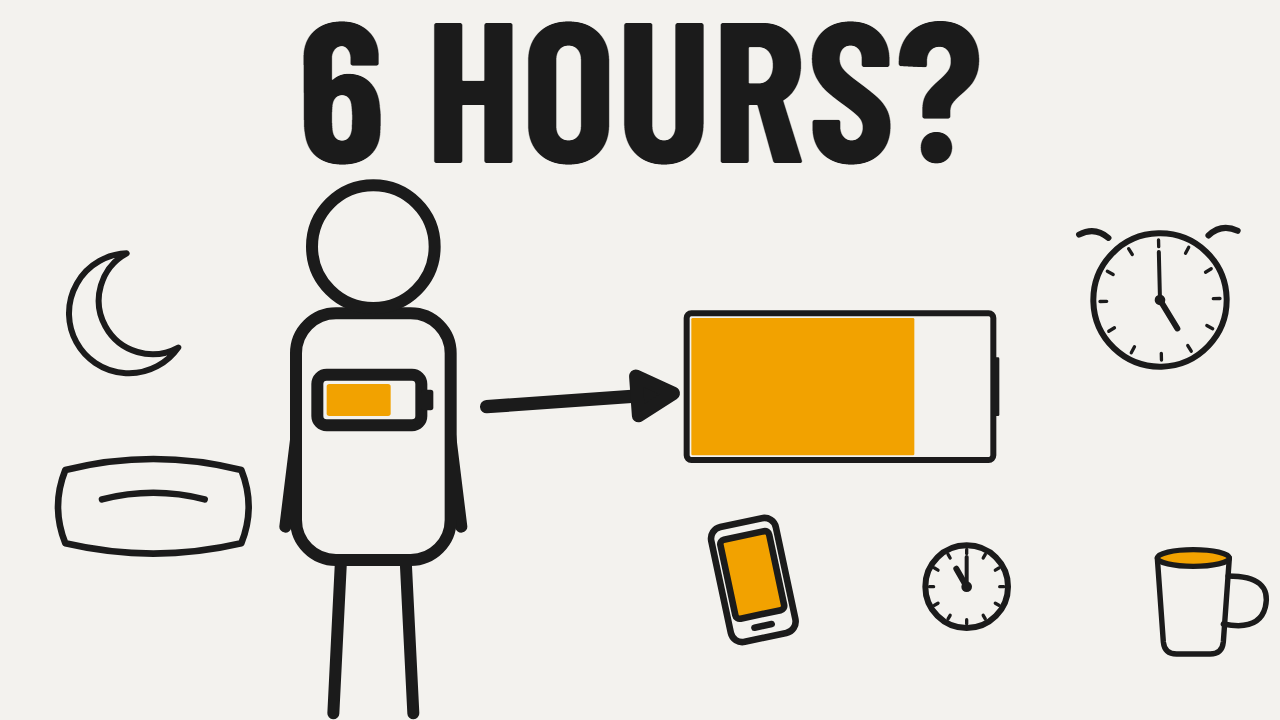
In short: after a few days of six-hour nights, the feeling of being sleepy levels off, but performance in lab tests doesn't. You haven't adapted to six hours. Your gauge just stopped complaining.
Day by day
Day one. Think of sleep as charging your battery overnight. Eight hours fills it up; six hours leaves you at about seventy-five percent. Not an emergency, just a little short, and you start the next day from there.
Day three. Same shortfall, but now it stacks. Researchers call it sleep debt. In this manual we call it the overdraft: every short night borrows from the next day.
Day seven. In 2003, a team led by Hans Van Dongen kept healthy adults in a lab for two weeks, with eight, six or four hours in bed per night. The six-hour group got worse and worse on attention tests, and they were still getting worse at the end of two weeks. But when asked how sleepy they felt, their ratings leveled off after the first few days. They didn't notice.
Another team, led by Gregory Belenky in 2003, kept people at three, five, seven or nine hours for a week. At seven and five hours, performance dropped, then settled at a lower level. The authors said the brain adapts, but at a reduced level. Only the nine-hour group stayed at baseline.
In 2013, a team in England led by Carla Möller-Levet had twenty-six people sleep just under six hours a night for one week, and then took blood samples. More than seven hundred genes changed their activity, and the body's daily rhythm in gene activity got weaker. Nobody knows yet what that means for health, and it was a small study, but it suggests a week of short sleep is more than just "a bit tired."
Three small fixes
- Find your number. In 2015, the American Academy of Sleep Medicine and the Sleep Research Society said adults should regularly sleep seven or more hours. Don't jump to eight tonight: move bedtime thirty minutes earlier for a week, and watch your "how sharp am I, 1 to 10" number. The first three nights you might feel restless. That's your body learning a new schedule. Small deposits every night beat a big sleep-in on Sunday and a crash on Monday.
- Protect the night you have. Six hours of broken sleep is worse than six hours of good sleep. If you can't go to bed earlier (kids, shifts, neighbors, a bedroom that's bright by five-thirty), light and noise still cut into the sleep you get. A plain, comfortable sleep mask blocks the light. It won't give you an extra hour, but it can protect the hours you have.
- Anchor the morning. Pick one wake-up time and keep it, even on weekends, within about an hour. Your body clock runs on repetition: waking at six-thirty on Friday and ten on Saturday is a tiny case of jet lag, and Monday feels like landing in another time zone. Open the curtains the moment you're up: morning light is the strongest nudge your body clock gets.
Self-test: do you need an alarm every single morning? Do you sleep much longer on days off? Do you need coffee just to feel normal? If you said yes to two of three, that might be your overdraft showing up. It might also just be a hard season of life, and that's okay.
Recommended part
A plain, comfortable sleep mask: not a fancy one, just one that blocks the light and doesn't press on your eyes.
No mask? A dark scarf and a closed curtain do the same job.
As an Amazon Associate I earn from qualifying purchases.
The fair verdict
Six hours isn't a crime, and some people really do need less. In 2009, a team led by Ying He and Ying-Hui Fu found a family where two members slept about six and a quarter hours a night, compared with about eight for their relatives. They shared a rare variant in a gene called DEC2. But it's very rare: the researchers didn't find it in any of two hundred and fifty other people. If you're not sure, chances are you're not one of them.
You also don't need all three fixes. Pick one. A rough week doesn't undo you.
If you're getting seven or eight hours and you're still exhausted every day, or you snore loudly, or you stop breathing at night, talk to a doctor.
Your challenge for the next 7 days
Move bedtime thirty minutes earlier and keep the same wake-up time. Write down two numbers each morning: hours slept, and how sharp you feel (1 to 10). On day seven, compare them with the numbers you wrote at the start. Did sharp go up?
Next chapter: what happens to your body during a twenty-minute nap.