 The Energy Manual
Chapter 05 · 2026-10-11
Coffee First Thing? What Happens to Your Body (and a Timing Trick)
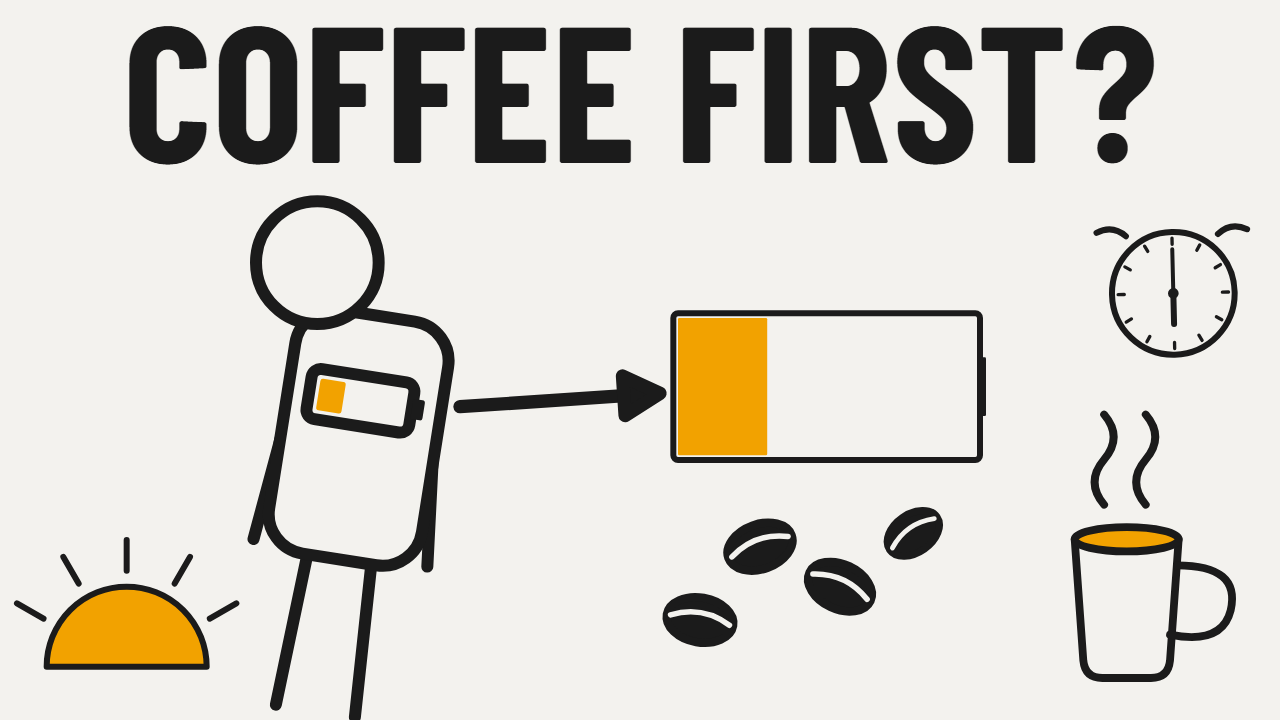
In short: coffee first thing isn't a hormone disaster, and the popular "wait exactly 90 minutes" rule has never been tested. What does hold up is simpler: your body already gives you a morning boost, a daily habit blunts the cortisol effect of coffee, and a late cup can cost you sleep without you noticing. You don't have a coffee problem. You have a timing problem.
What happens, minute by minute
Minute zero. You wake up, and before you touch anything your body starts to raise cortisol, a hormone that helps you get going. Researchers call this the cortisol awakening response. It isn't stress: it's a built-in start button, and it climbs over roughly the first thirty to forty-five minutes after you open your eyes.
Minute fifteen. You drink the coffee. Caffeine blocks adenosine, the chemical that builds up all day and tells you you're sleepy. It doesn't delete the sleepiness, it just blocks the receiver, so the message keeps being sent. Think of it as tape over the low-battery light on a dashboard: the tank is just as empty, you just can't see the warning.
The hormone part. Caffeine can push cortisol up on its own. In a 2005 study, William Lovallo and colleagues gave caffeine to 96 healthy adults. After five days without it, the cortisol jump was big. But people who took caffeine every day for five days barely had that jump at their morning dose, because their bodies had gotten used to it. One study isn't the final word, but it fits what many regular drinkers report: the more you drink, the less each cup gives you. For a daily drinker, a lot of what you feel might just be getting back to normal.
Hour five. Caffeine has a half-life of roughly four to six hours, so by lunchtime a chunk of your morning cup is still in your system.
Three small fixes
- Give your body a head start. Before the coffee, drink a glass of water and get real light on your face: a window, a porch, a walk to the mailbox. About that ninety-minute rule: nobody has tested that exact number, so treat it as an experiment, not a law. Try waiting until the first fog lifts, maybe thirty to sixty minutes, and see how you feel. The first three days you might feel restless or foggy, and that's the reset working. If you slept badly, take the coffee: caffeine does help after a short night.
- Light before latte. Morning light is one of the strongest signals your body clock gets. The sooner it lands, the less work the coffee has to do.
- Set a caffeine curfew. In a 2013 study, Christopher Drake and colleagues gave 12 healthy adults 400 mg of caffeine at bedtime, three hours before, or six hours before. All three times, sleep got worse than with a placebo, and six hours before bed they lost more than an hour of sleep, measured with a sleep monitor. They didn't notice. Count back six hours from your bedtime: if you go to sleep at eleven, your last real cup is around five.
Recommended part
If it's still dark when you wake up, there's no window to stand in at 5:40 a.m. A sunrise alarm clock is a lamp with a clock inside: about half an hour before your alarm it starts to glow, slowly, like a sunrise in your room. It won't fix a four-hour night, but it takes the harshest part out of the morning, and the coffee can be the cherry on top instead of the whole sundae.
No lamp? Open the curtains the second you're up. Same idea, free of charge.
As an Amazon Associate I earn from qualifying purchases.
Your challenge for the next 7 days
Do one thing before your first cup: a glass of water, a look at the sky, anything. And note what time your last coffee is. On day seven, ask yourself one question: did the coffee change, or did I?
Self-check: what time was your last coffee yesterday, what time did you fall asleep, and how did the alarm feel? If the last cup was late, the sleep was rough and the morning was foggy, you've found the loop: the late coffee costs you sleep, and the lost sleep makes you need the morning coffee. The curfew breaks it at one point.
Hitting the coffee first thing isn't ruining your life. If you have a heart condition, are pregnant, or take medication that interacts with caffeine, ask your doctor what's right for you. And if you're constantly exhausted no matter what you try, that's worth a conversation with a doctor too.
Next chapter: what actually happens to your body when you hit snooze.